- 20:05 h
- 75.59 km
- 810 m
- 1,191 m
- 121 m
- 518 m
- 397 m
- Start: Stiege, Selketal Railway station
- Destination: Quedlinburg, Karl-Ritter-Platz
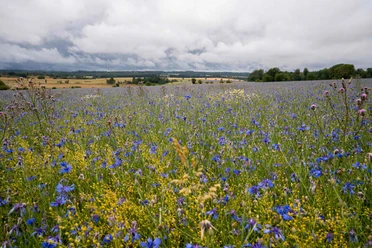
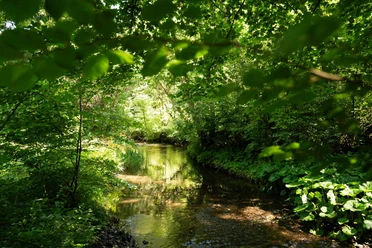
To experience the Selke Valley on foot means to enjoy pure nature, admire varied landscapes and experience living history.
Bremke, Wormke or Romke are typical Harz water names. The Selke is the largest stream of this name family. In fact, it is already a river. The Selke's catchment area in the Harz is rich in history and allows the attentive hiker a comprehensive insight into past centuries. The Selke flows through the duchy of the "Anhaltiners". Here lies their ancestral castle, Anhalt Castle, now a ruin, as well as a former residence, Ballenstedt Castle, with its magnificent baroque garden and the burial place of Margrave Albrecht the Bear, the ancestor of the Ascanian dynasty and later Anhaltiners.
Mining was also carried out in this small duchy. Silver and even some gold were found, so coins could be minted here. Later, iron processing played a role, which was also carried out artistically in the form of iron casting. A state spa with a strong steel spring (Alexisbad) was to bring prosperity to the duchy in the 19th century. Later a narrow-gauge railway was built, which still exists today and offers tired hikers a comfortable alternative. On the Selke lies the place where more than 150 years ago technological history and, 800 years ago, German legal history were written.

Pavements
- Asphalt (14%)Trail (43%)Gravel (29%)Street (4%)Path (10%)
Best to visit
- suitableDepends on weather
Directions
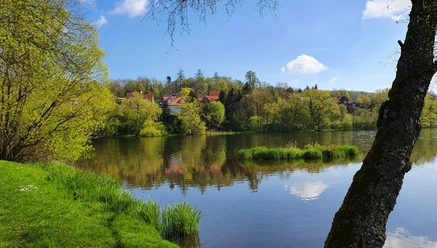
The starting point is the station in Stiege at the smallest turning loop of a narrow-gauge railway, the Selketalbahn, about 485 m above sea level. From here it goes always along the Selke and the Selketalbahn past the Albrecht House, a former sanatorium built around 1900. From the Friedrichshöhe stop, the rails of the Selketalbahn accompany us through the Upper Selke nature reserve to the mill pond (mountain lake) in Güntersberge. To the right on the Kohlberg lie the ramparts of the so-called Güntersburg, with 3.1 ha one of the largest in the Harz. At the edge of town the Selketal-Stieg crosses to the northern side of the Selke and the Selketalbahn and follows the river to Straßberg station. Here the now visitor mine Grube Glasebach mined fluorspar until 1989. Without this fluorspar deposit, the Selketalbahn would no longer exist. On the way to Silberhütte station we pass the Unterharzer Waldhof - an information and experience area on the subject of forest - a good place for a break.
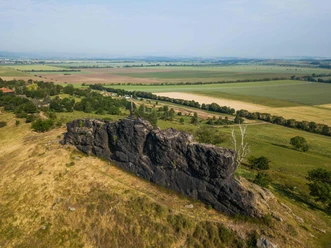
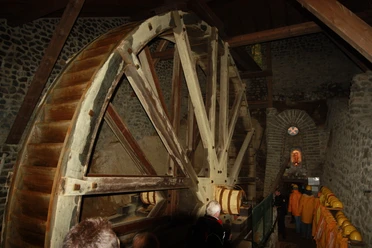
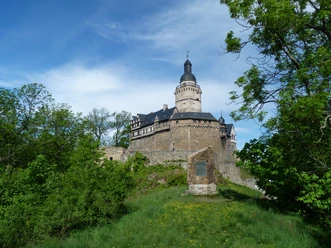
Shortly before Silberhütte station the path climbs to the 400 m high mill heads to the Hänichen art and nature farm. It then goes downhill towards Alexisbad, founded in 1810 by a strong steel spring and the first spa town of Anhalt. We leave the town to the left, cross the Selke on the sulphur bridge, walk alongside the Selketalbahn to the federal road 242, which is not crossed but ascended in several hairpin bends to the Habichtstein. At the top the cliff path is reached, which leads to the left through the designed park landscape of "Alexis-Bad". The cliff path leads, almost level, comfortably through the rocky valley slope of the Selke. It connects the Habichtstein rock with the Schalkenburg rock and the rock of the Mägdetrappe. The Selketal-Stieg leads down to the former smelting site Mägdesprung with the Carlswerk industrial museum - the still visitable machine factory. Behind Carlswerk Mägdesprung a bridge crosses the Selke. From here we hike downstream along the southern bank of the Selke. The valley now widens and offers a unique flora and fauna over 8 km in length in the nature reserve. The next destination is Falkenstein Castle, the best preserved medieval castle complex in the Harz. Anyone wishing to visit the castle must leave the Selketal-Stieg about 300 m after the Thalmühle hotel on the right and hike on the Eselstieg to the castle. The Selketal-Stieg continues along the northern bank of the Selke to Meisdorf (Falkenstein town).
After passing the nature trail along the Selke, we come to the Schloss Meisdorf hotel complex, leave the Selke and turn west towards Ballenstedt. A rest stop is recommended in the Ballenstedt castle park to experience the park laid out in the Italian style with its water axis by the royal Prussian garden director Lenné.
After leaving the park, the Selketal-Stieg leads on the Fürstenweg past the Roseburg, which also has a very beautiful landscape park. We hike along the edge of the Harz towards Gernrode with views over the Harz foreland. The Selketalbahn is crossed at Osterteich. On the Schwesternweg and Herrenbergsweg the town of Gernrode is bypassed.
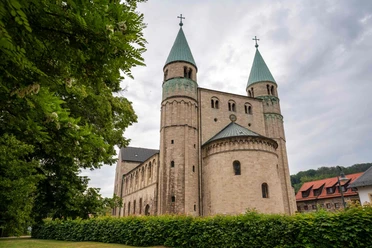
It is really not enough here to just look down on the collegiate church of St. Cyriakus. The church building, over 1000 years old, is one of the oldest churches in Northern Europe and the only almost unchanged building from Ottonian times. As if by a miracle, an extraordinary room made of stucco in the southern side aisle has survived the ages, the oldest replica of Christ's tomb in Germany.
On the panoramic path we reach Bad Suderode. We cross it in a northerly direction, cross the track of the Selketalbahn between Gernrode and Quedlinburg, pass the first Bückemühle west of the Quarmbach towards Quarmbeck. Parallel to the Selketalbahn the path leads to the Quarmbach settlement. On the Schafbrücke we cross the Bode. We reach the UNESCO World Heritage town of Quedlinburg through Brühl Park, an English-style extended landscape garden. Over Brühlstraße and Wordgarten we reach the end of the Selketal-Stieg at Carl-Ritter-Straße.Directions & Parking facilities
- Getting there
To Stiege via the B242 between Harzgerode and Braunlage
ParkingSufficient parking facilities at HSB station Stiege and in all towns
Public transportationHarz narrow-gauge railways (HSB) and bus. Information at www.hsb-wr.de and www.bahn.de
Additional information
Author
Harzer Tourismusverband
Organization
Harz: Magische Gebirgswelt
License (master data)

Author´s Tip / Recommendation of the author
Hiking package from "Wandern im Harz" for the Selketal-Stieg
On the Selketal-Stieg from Quedlinburg to Stiege - 3 stages - 4 overnight stays from €405 per person in a double roomSelke-Bode Valley-Stieg - 6 stages - 7 overnight stays from €565 per person in a double room
Map
Selketal-Stieg - Official hiking map scale 1 : 50,000, contour lines every 20m, Harz club hiking trails, UTM grid format 75 x 160 mm, 675 x 480 mm (opened) ISBN 978-3-936185-45-4 Schmidt Book Publishing, Wernigerode Price: €2.50 The East Harz - hiking and cycling map scale 1 : 30,000, UTM grid for GPS, contour lines every 20m, Harz club hiking trails, signposted cycling paths, MTB and cycle tour recommendations format 110 x 200 mm, 990 x 600 mm (opened) ISBN 978-3-936185-74-4 Price: €4.00