Mystic route: Klusberge


- 1:09 h
- 3.87 km
- 92 m
- 92 m
- 126 m
- 188 m
- 62 m
- Start: Car park "vor der Klus 1"
- Destination: Car park "vor der Klus 1"

Good to know
Pavements
- Street (3%)Path (78%)Trackless (6%)Trail (4%)Unknown (3%)Asphalt (6%)
Best to visit
- suitableDepends on weather
Directions
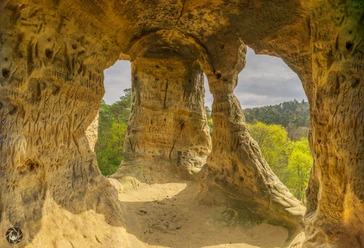
You start from the car park "Vor der Klus 1" and take the north slope path to get to the Devil's Pulpit. Along the way, you pass the well-known shepherds' cave in the Klusberge. However, it is not the only one, as the Klusberge were once treeless and sheep kept the pastures low. To protect themselves from, for example, unfavorable weather conditions, the shepherds built the caves in the soft sandstone. The Devil's Pulpit is the third prominent rock in the Klusberge. However, it is not as isolated as, for example, the Five Finger Rock or the Klusfelsen. According to an old map, it was once called Devil's Chair.
Continue following the main path and you will reach a beautiful viewpoint. A little further on is Amtsberg, where the remains of a lookout tower are still visible today. Then continue along a footpath on the left to the Klusberge (see map). The Klusberge seem to have come straight out of an old painting by Caspar David Friedrich. Picturesquely, they rise at the gates of Halberstadt. Thousands of years ago, there was already an observatory here from which the course of the stars was observed. Recently, near the construction of the bypass road in Harsleben, a circular ditch system was discovered. About 3,500 years ago, two women were buried there, whose rich jewelry indicates their special origin and status. The Klusberge are a direct extension of one of the sight axes of the Sunken Sanctuary (here the Fox Cliff and the Goat Head). The Klusfelsen are a unique testimony of German history. Around 1516, the Klusfelsen were used by a fraternity of shepherds and herders. A document from that year describes "the shepherds of Halberstadt and surroundings had locked in their wives and children, founded a fraternity, and endowed the chapel of the Holy Cross in the Klus, also called Kenstein, with sheep and alms. Holding of requiem masses for deceased shepherds and prayers for the souls of the living." This shows that the small cave with the carved cross really served as a chapel.
Afterward, continue past the prominent Klusfelsen to the Five Finger Rock. This place generally has a very mystical atmosphere. Many fish heads or carved bodies can be seen on the walls. In addition, the area has many places with benches, steps, and distinctive holes. On top of the battlements is a strong plate depression in the middle, which may once have been intended for the leader. Next to this is another hole about 30 cm deep. On the rear chair, there is a summit register for climbers (only suitable for experienced climbers). According to an old map, the Five Finger Rock was formerly called Devil's Chair.
You keep to the right and reach the Ypsilanti Spring via a path. This spring was once one of the natural sanctuaries of our ancestors. It spouted many liters per second, thus it was quite the size of a stream and was highly revered.
To the right, along Molkenmühlenweg, you go along the forest edge of the Klusberge up to a barrier, which can be passed without worry. Then turn right onto the path that leads you straight past the Klus and Five Finger Rocks. Now go down a somewhat steeper slope that looks like steps, and you will reach a path that leads straight past the Aviator Memorial back to your starting point.
The Aviator Memorial shows a large commemorative plaque on a vegetated natural stone wall. It is located about 20 m north of the forest path and next to the shooting range house. The Aviator Memorial was erected for six aviators who died in the crash of a giant aircraft of the Linke-Hofmann R.I (R14) type on 19.08.1917 near Halberstadt. They belonged to the giant aircraft department 500 and had taken off from the Halberstadt airfield. The aircraft already had a wingspan of over 30 m and a take-off weight of 9,000 kg at that time.
Directions & Parking facilities
Author
Stadt Halberstadt
Organization
Harz: Magische Gebirgswelt
License (master data)
Author´s Tip / Recommendation of the author
Sturdy and non-slip footwear
Map
Circular hiking trails through the Halberstadt mountains, available at the Halberstadt Tourist Information
Nearby


Download GPX file