Historic City Fortifications of Goslar

- 1:00 h
- 3.00 km
- 36 m
- 23 m
- 247 m
- 282 m
- 35 m
- Start: Breites Tor
A walk along the southern ramparts leads to architectural testimonies of the historic city fortifications, to relics of the Rammelsberg mining directly outside the city gates, as well as to the Imperial Palace. Information stations along the way provide details about the sights. Goslar was surrounded by a city wall since the 12th century. The initially three to four meters high wall was crowned with battlements and had a wooden defensive walkway on the city side. Four main city gates equipped with portcullises guarded the city entrances. With the development of firearms and cannons around 1500, the city wall had to be structurally reinforced. First, the inner city wall was heightened and the wooden, easily flammable defensive walkway was removed. Effective protection against cannonballs was provided by high earth ramparts built in front of the city walls. Additional moats and an outer city wall, called the field wall, were intended to prevent enemies from entering the city. The city gates were reinforced by flanking towers and forward defense towers. At strategically important points, powerful defensive towers (Zwingers) were also constructed. The old town of Goslar, together with the historic Rammelsberg ore mine and the so-called Upper Harz Water Management System, has been part of the UNESCO World Heritage since 1992. The ramparts, along with the existing remains of the medieval and early modern city fortifications, are an essential part of the World Heritage area.

Good to know
Best to visit
Directions
Southern fortifications and ramparts with architectural testimonies of Goslar’s city and mining history
The city of Goslar possesses extensive relics of a medieval and early modern city fortification: city walls, city gates, and defensive towers as well as artificially built earth ramparts and moats surrounded the historic city and can still be experienced in many places. A walk along Goslar's southern ramparts leads to important sights of the city fortification, as well as to historic testimonies of the Rammelsberg mining and the Imperial Palace.
The route begins at the so-called Breites Tor (Broad Gate) at the eastern end of Breite Straße, with an overview panel about the historic and still preserved parts of the historic city fortifications. The Breites Tor itself is one of four formerly existing main gates of the city. Leaving the old town through this historic city gate, you enter the former forecourt of the Breites Tor, surrounded by a flank tower directly attached to the city gate, a mighty zwinger tower (northern zwinger), as well as a former barracks building for the gate guards with the adjoining southern zwinger tower. Passing the former barracks (called “Werderhof” since the late 19th century), a footpath branches off towards Osterfeld (Brieger Eck towards “Municipal Sports Facilities”). There is an information panel about the overall situation of the Breites Tor here.
Just a few meters further you can discover the Ocker swamps. These are former settling basins for the Rammelsberg mine water, which was diverted until just before the city walls via a drainage tunnel completed in the 16th century, the “Deep Julius Fortunatus Tunnel.” From the iron oxide-rich mine waters, the pigment “ochre” could be obtained here. An alley branching off to the southwest alongside a supply channel leads directly to the tunnel entrance. Behind an inconspicuous door is the access to the 2.6 km long tunnel, regarded as one of the most important mining monuments in the Lower Harz.
Above the tunnel entrance is a castle-like structure that served to protect a water flow. Here the so-called Abzucht, an artificial watercourse crossing the old town area to drive mills, flows out of the city. To prevent enemy entry, this water outlet was secured by city gate-like towers including a forework. The structure was integrated into a city wall, which is clearly visible along the further route. Originally, the medieval city wall was only three to four meters high and crowned with battlements. Behind the battlements ran a wooden defensive walkway on the city side. Due to the development of firearms and cannons, the easily flammable wooden walkway was removed around 1500 and the city wall was raised to up to six meters. Half-round defense towers attached on the outer side of the city wall served surveillance. Additionally, artificially built earth ramparts and moats were meant to protect the city from shelling. A second city wall, the so-called field wall, was built around this time as the outer defensive ring.
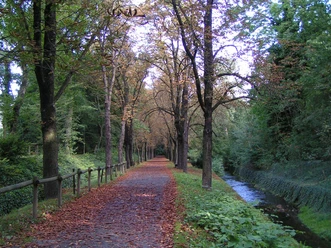
This extension of the medieval city fortifications by ramparts and moats is clearly visible in the area of the “Judenteiche” (Jews’ Ponds), which represent the remains of a former water moat. Following the lower path along these ponds, a high, artificially built earth rampart can be seen on the right. Beyond the ponds, the outer city wall is still almost fully preserved. The origin of the name “Judenteiche” is unclear, though the moats in this section of the ramparts have already been referred to as such in the 18th century. In the ponds is an artwork by the Israeli artist and Kaiserring winner Dani Karavan. The two wooden frames, which are parts of a “bridge” without a connecting piece, were originally painted white and are intended to symbolize the necessity of human and cultural bridging. Due to the weathering of the wood material, the artwork is increasingly deteriorating. However, it is the artist’s wish to renew the work only after complete decay to symbolize the cycle of life.
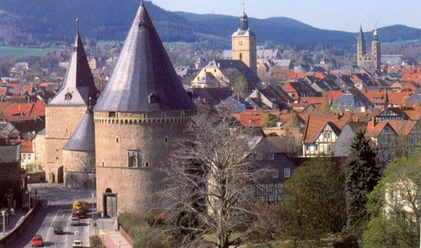
Further along the ramparts, you reach the “Dicke Zwinger” (Thick Zwinger), a mighty defensive tower formerly topped with a high conical roof. Built at a strategically important point on the rampart crest, enemies breaching the ramparts could be shelled with cannons. The tower currently houses a privately run “Medieval Museum” open for visits.
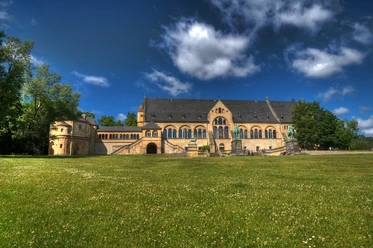
Passing the Dicke Zwinger, you arrive at the Kahnteich, which is also a remnant of the moats. Here again, earth rampart and outer city wall are still clearly visible. Further along, the ramparts were altered by a 19th-century barracks building, so you now have to turn into Wallstraße towards the city center. Crossing Wallstraße at the signpost “Kaiserpfalz,” you will already see the magnificent palace building, probably built between 1045 and 1050 by Emperor Henry III on the site of a predecessor building dating to around the year 1000 and the site of numerous imperial assemblies during the Middle Ages. Opposite the Imperial Palace, Henry III had a church with cloister built, of which only the porch remains. An information panel on the southern path to the Imperial Palace provides an impression of the palace district buildings.
The Imperial Palace was located within the city fortifications at least since the 13th century. Behind the palace building—in the so-called palace garden, open until October 15—significant remains of the city wall are still preserved. A gate in this city wall leads back out to the historic ramparts. Following the serpentine path, you reach the so-called Upper Waterhole, the counterpart to the Lower Waterhole. The entrance of the Abzucht into the city was also secured by a special structure spanning the watercourse. The flow could be closed by a portcullis.
Finally, you reach the site of the former Klaus Gate, another important city gate of Goslar. The Klaus Gate lay on a connecting path between the old town and Rammelsberg, as well as near the Harz trade route (today the road to Clausthal-Zellerfeld). Of the former city gate, only a chapel formerly adjoining the gate building remains. This was integrated into the city wall, evidenced by still visible loopholes in the south wall.
Here ends the walk through the southern ramparts. Following Bergstraße into town, you reach the center of the old town, passing notable bourgeois houses such as the Siemens House (ancestral home of the Siemens family) or the so-called Brusttuch, a 16th-century residential building of a wealthy smelter owner.
Directions & Parking facilities
A7 Hamburg / Hannover towards Kassel or Kassel / Göttingen towards Hannover
AS Rhüden (Harz) / Goslar and via the B82 to Goslar
A395 coming from Braunschweig
AS Goslar via the B6 to Goslar
- Train: Direct connections from/to Hannover, Halle (Saale), Braunschweig, Göttingen, Kreiensen
- Bus: Direct connections from/to Salzgitter Bad, Bad Harzburg, Clausthal-Zellerfeld, Vienenburg, Wolfshagen, Liebenburg, Altenau, Langelsheim
Literature
Bauer, Christine H., Goslar: Kings, Emperors and Mine Lords, in: Rammelsberg Mine, Old Town Goslar and Upper Harz Water Management, ed. by the City of Goslar, Goslar 2017, pp. 54 ff.
Bauer, Christine H., The historic city fortifications in the UNESCO World Heritage "Old Town of Goslar", in: Restoration of historic city walls, planning – execution – maintenance and care, expert colloquium on November 10, 2015 in Goslar, ed. by Christine H. Bauer and Gabriele Patitz, Stuttgart 2016, pp. 11 ff.
Griep, H.-G., The Fortifications, Goslar 1992 (= Guide through Goslar, vol. 5)
Author
Stadt Goslar
Organization
Harz: Magische Gebirgswelt
License (master data)
Nearby