- 2:00 h
- 3.49 km
- 27 m
- 27 m
- 261 m
- 280 m
- 19 m
- Start: Market square Goslar
- Destination: Market square Goslar

Harz: Magische Gebirgswelt
Pavements
- Asphalt (70%)Street (19%)Trail (6%)Unknown (5%)
Best to visit
- suitableDepends on weather
Directions
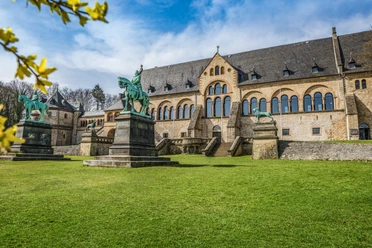
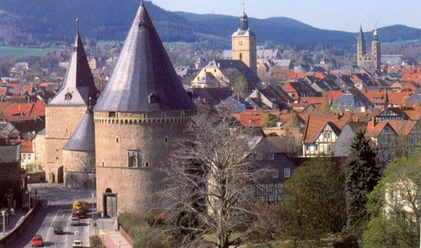
- If you walk past the town hall on the left, you will find the Market Church of St. Cosmas and St. Damian with its precious treasures. The tower today offers a magnificent view at about 60 m height. From the church, walk left along Hohen Weg. A few steps lead you over the Königbrücke, already mentioned in the 12th century, from the civic area into the palatinate district. Behind the bridge on the right is the Great Holy Cross, a former hospital from 1254 with the small St. John's chapel and artisan studios. Following Hohen Weg, you reach the Kaiserpfalz parking lot, the former site of the imperial collegiate church of St. Simon and St. Judas from the 11th century, which was demolished in the early 19th century. Today, the outlines laid in the pavement and the preserved entrance porch testify to this important building. In the porch is the Imperial Chair, whose original bronze armrests from the 11th century can be admired in the winter hall of the palatinate. The path leads either right or left uphill to the palatinate building, from where you can enjoy a wonderful view over the roofs of the old town. (From April 1 to October 15, you can continue your way past the palatinate building on the left, then pass the city wall and go through the palatinate garden to the Klaus Chapel.) Left in front of the palatinate entrance, stairs lead down to the street “Am Liebfrauenberg” with many houses typical for Goslar clad with slate. Before you cross the bridge over the Gose stream along the street, on the left, there is an ensemble of half-timbered houses from different eras. On the other side of the bridge, you reach the Upper Water Hole on the left, the entry point of the Gose under the city wall into the old town. On the right of the water hole, continue to the street “An der Gose”, which you follow left until it meets Bergstraße. There on the left side is the Klaus Chapel, a former gate chapel from the 12th century, still used today by the Frankenberg parish. The path goes a few meters back and left to Peterstraße, at the beginning of which stands an old shepherd’s house from the 16th century as an eye-catcher. This street with the typical cobblestones of Goslar shows, on the left side, numerous former miners' houses from the 15th to the 17th century. At the end of the street, turn right to the Frankenberg Square with a fountain replica from the 16th century. On the left is the Small Holy Cross, one of Goslar’s hospitals from the late 14th century, today in baroque form. On the right of the hospital, under the gate, go up to the Frankenberg Church of St. Peter and St. Paul, a Romanesque basilica from the 12th century with a baroque dome on the tower. From the way up to the church, there is a beautiful view southward to Rammelsberg. Descending again, on the left is a late Gothic gate leading to a former monastery area. Then turn left into Kettenstraße, then right into Beekstraße, both previously belonging to the residential district of the miners. Continue straight ahead, cross Bäringerstraße, and follow Jakobistraße to the Mönchehaus Museum, where you will find contemporary art presented inside and outside. Over Obere Schildwache, the path leads to Zehntstraße and then right to the former city gate “Vititor”, from which the semicircular flanking tower is still visible. Over Vititorwall, it goes to a bridge leading to the area of the Neuwerkkirche, which was built as a monastery church in the 12th/13th centuries. It is preserved purely Romanesque inside and outside. The path around the church leads to a Romanesque monastery garden on the south side with medieval medicinal and useful plants. On the east side of the church, a gate goes through the still 10 meters high city wall with battlements to Hotel Achtermann, which has incorporated parts of the former city gate into the building complex. A passage leads right into Rosentorstraße, where modern art in the form of a figure couple greets visitors. On the right follows the former collegiate building of the monastery from the early 18th century as a half-timbered Baroque building, which once housed, among others, the civil registry office of Goslar. Rosentorstraße continues to Jakobikirche, whose oldest parts date back to the 11th century. Today it is the only Catholic parish church in the old town. Then continue right into Bäckerstraße, then left into Münzstraße, where the city mint was located from 1500. From this time comes the bronze seal above the former entrance with the sword of justice, crown, and defenders of the city saints St. Simon and St. Judas. From here, the path leads left to Schuhhof, Goslar’s older market with half-timbered houses from Gothic to late Renaissance and the former shoemakers’ guild house. Near the market square, where there are numerous places to rest, this tour ends.
Directions & Parking facilities
- Getting there
- A7 Hamburg / Hannover towards Kassel or Kassel / Göttingen towards Hannover
- Exit Rhüden (Harz) / Goslar and via the B82 to Goslar
- A395 from Braunschweig direction
- Exit Goslar via B6 to Goslar
Parking- Parking lot Kaiserpfalz Nord
- Parking lot Marktstraße
- Parking lot Christian-von-Dohm-Platz
Further parking options can be found at www.goslar.de
Public transportation- Train: Direct connections to/from Hannover, Halle (Saale), Braunschweig, Göttingen, Kreiensen
- Bus: Direct connections to/from Salzgitter Bad, Bad Harzburg, Clausthal-Zellerfeld, Vienenburg, Wolfshagen, Liebenburg, Altenau, Langelsheim
Additional information
- Tourist Information Goslar
Markt 7, 38640 Goslar
Tel. 05321 78060
tourist-information@goslar.de
www.goslar.de Author
Marina Vetter
Organization
Harz: Magische Gebirgswelt
License (master data)