- 3:10 h
- 39.34 km
- 366 m
- 102 m
- 119 m
- 394 m
- 275 m
- Start: Quedlinburg - Brühlstraße, corner of Kaiser-Otto-Straße and Am Schiffbleek
- Destination: Harzgerode marketplace
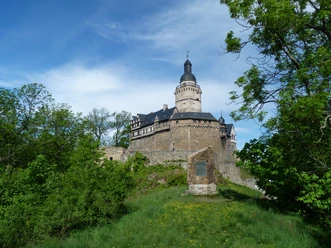
The route leads from the UNESCO World Heritage and half-timbered town of Quedlinburg through the towns of Bad Suderode, Gernrode, and Rieder to historic Ballenstedt. Between Rieder and the officially recognized spa town, the Roseburg built in 1908 entices with a true fairy tale castle atmosphere. Just a stone's throw away, a detour to the majestic Ballenstedt Castle located on the Romanesque Road is worthwhile. The castle park invites you to linger and enjoy an extensive break. The route continues through Ballenstedt to Meisdorf, where the local castle and mausoleum are passed. Afterwards, the path follows the course of the Selke river in the idyllic nature reserve "Upper Selke Valley." At the junction before the III. Hammer, the Selke is crossed and then the much smaller Schiebeckbach is followed past the Stammrod diabase quarry to Harzgerode. The stage ends at the marketplace with its historic town hall.

Pavements
- Gravel (13%)Asphalt (17%)Path (6%)Trail (48%)Street (15%)
Best to visit
- suitableDepends on weather
Directions
- We leave the historic UNESCO World Heritage and half-timbered town of Quedlinburg and first cross the Bode on a trail parallel to Turmstraße and Harzweg. On a cycle path at the edge of Gernröder Weg, we ride southwards and reach the northern part of the spa town Bad Suderode via the cycle path on Suderöder Chaussee and the street at Bückeberg. On a path above the rail line of the Selketalbahn, we get our first glimpse of Gernrode with its impressive collegiate church of Saint Cyriakus. We briefly head towards Rieder and then turn right onto Kahlenbergweg before shortly afterwards turning left onto the paved railway cycle path. We follow this without major elevation changes and pass the fairy-tale Roseburg on its southern side. A detour is worthwhile because the Sleeping Beauty castle, built in 1908 by Bernhard Sehring after a medieval model, is truly a eye-catcher. The park designed in the style of Italian and English landscape gardens invites a pleasant stroll. We continue along the railway cycle path to Ballenstedt. Here too, it is worth briefly leaving the path to visit the castle and castle park. The majestic castle is located directly on the Romanesque Road and offers insight into the history of Saxony-Anhalt with interesting permanent exhibitions. Ballenstedt itself was the ancestral seat of the Ascanian dynasty and the residence of the dukes of Anhalt-Bernburg. We cross the town on Steinbergstraße and cycle along the city cemetery towards Opperode. We pass the cyclist's chapel of St. Petri and then stay parallel to the main road to Meisdorf. Here too, we pass a castle. Meisdorf Castle was built in 1708 and today serves as a hotel. We ride straight ahead along the avenue towards the mausoleum, a neo-Gothic burial site of the counts of Asseburg-Falkenstein. We follow the cycle path oriented along the course of the Selke. We repeatedly get close to the water or even cross the river, as is the case several times on Falkensteiner Weg. Our route leads right through the nature reserve “Upper Selke Valley.” Numerous rest areas in idyllic nature make the choice difficult when looking for a break spot. Between the IV and III Friedrichhammer, we turn left at Herzog Alexis Erbstollen and are now accompanied by the Schiebeckbach. In the Selke valley, an ironworks was established in 1646 under Prince Friedrich of Anhalt-Harzgerode, and along the Selke there were a total of four hammer mills from I to IV. The settlements founded back then still exist today and are called Hammer 1 to 4. Our further path leads past the Stammrod diabase quarry until we meet path K2344, which we follow to the officially recognized spa town Harzgerode. Our stage ends on the marketplace with its impressive half-timbered town hall.
Author
Andreas Lehmberg
Organization
Genuss Bike Paradies
License (master data)