- 3:40 h
- 13.38 km
- 187 m
- 187 m
- 223 m
- 403 m
- 180 m
- Start: Parking lot at Selkemühle (City of Ballenstedt)
- Destination: Parking lot at Selkemühle (City of Ballenstedt)
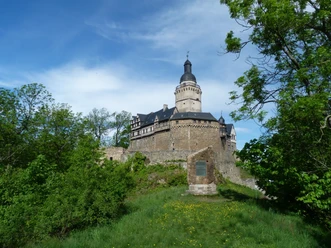
Probably built around 1100, destroyed in 1140 and rebuilt by Albrecht the Bear in 1146, the castle gives an impression of the size of the Anhalt princely house. The castle is one of the few buildings in the region made from locally fired bricks. The present Wilhelmshof forest house was built in 1682 as a farmstead by Prince Wilhelm of Anhalt-Harzgerode and used as a hunting lodge from 1690 until his death and the end of this line in 1709. Afterwards, it served as a residence with occasional beer serving. Today it belongs to the East Harz state forest enterprise. The adjacent Friederikenstraße is an old trade route between Aschersleben and Harzgerode and is named after the last duchess of Anhalt-Bernburg, Friederike, who contributed significantly to the expansion of traffic routes. On the return through the Selke valley, the forest settlement Tidian is on the right, containing an old tunnel. Around this, several legends provide insights into the activities of the Asseburg family on the Falkenstein.

Pavements
- Gravel (33%)Trail (31%)Path (5%)Street (31%)
Best to visit
- suitableDepends on weather
Directions
The starting point is the Selkemühle parking lot, which we can only reach by car from Mägdesprung through the Selke valley. We cross the Selke bridge and take the 'Herzogsweg' that turns left to climb up to Anhalt Castle. Although this route is longer than the direct ascent via a hollow path, it gradually leads upward and we always have the Selke valley in view during the first part of the path.
At the point where the path leaves the Selke valley and turns right into a small side valley, the former state border between Anhalt and Prussia (Falkenstein) runs along the stream, around which there have been frequent disputes in the past. After a hairpin bend that always runs along the hillside, we circle the Kleiner Hausberg, from which it is claimed that there was also a castle called "Kleine Anhalt", which was destroyed and not rebuilt. However, it is more likely that this was only an attempt to build a small fortification that was later abandoned. After a total of 2 km we reach the height where we turn right along a ridgeline and after another 400 m reach the ruins of Anhalt Castle. There are several attempts to interpret the name of the castle, but none appear conclusive. The origin of the castle is also not clearly clarified. It was probably built around 1100 by Count Otto the Rich and completed 10 years later. It was destroyed in 1140 but rebuilt from 1146 by Albrecht the Bear. Next to the castle was the village of Anhalt, which was probably founded at the same time as the castle. However, this is also not documented. The village was very large, intensive mining was carried out, and it was abandoned in the 15th century.
We then retrace the same path back to the junction of the Herzogsweg and continue straight ahead until we reach the Wilhelmshof forester’s house about 1 km on the right side of the path. This was built in 1682 by Prince Wilhelm of Anhalt-Harzgerode, a branch line of Anhalt-Bernburg, as a farmstead. From 1690 it served as the prince’s hunting lodge until this line died out in 1709. In the 18th century it was a residential house where beer was occasionally served. Today it is the forest house of the state forest enterprise. 100 m further, we reach the Friederikenstraße, the old connecting and trade road between Aschersleben and Harzgerode,
named after the last duchess of Anhalt-Bernburg, who made significant contributions to mining and road construction. On the Friederikenstraße towards Falkenstein, after just under 2 km from Wilhelmshof, we arrive at the Rauholz forester’s house, originally built as a wayside house and now privately used. Immediately behind the Rauholz forester’s house, which is located on Anhalt territory, runs the former state border between Anhalt and Prussia.After another kilometer, we turn left from Friederikenstraße into Annenweg and move always downstream toward the Selke valley, which we reach after 3 km. We are now on Selketalstraße, which is also the Selketalstieg, and turn left in the direction of Selkemühle, crossing the Selke on the Tidian bridge. Above the valley on the northern side of the Selke lies the forest settlement Tidian with the inaccessible Tidian cave, an old mining tunnel. There are valuable legends to be read about the Tidian cave that provide insight into the life and rule of the Asseburgs on the Falkenstein. After 700 m, the former state border crosses the Selke valley again, and after another 900 m we are back at our starting point, the parking lot at Selkemühle.
Equipment
Sturdy footwear, weatherproof clothing
Directions & Parking facilities
- Getting there
From Quedlinburg via Gernrode L 243/B 185 to Mägdesprung, from Aschersleben via B 185, Ballenstedt to Mägdesprung, then turn into the Selke valley to the end of the street
ParkingSelkemühle parking lot in the Selke valley
Public transportationBus to Mägdesprung, then 5.4 km on foot
Additional information
- Tourist information Falkenstein/HarzOT Ermsleben
Tourist information in the town hall of Falkenstein/Harz
Markt 1
06463 Falkenstein/Harz
Tel: 034743 96101
Postfach@stadt-falkenstein-harz.de
www.stadt-falkenstein-harz.de Literature
Feist, Peter; Anhalt Castle: The place that gave the region its name, Homilius Berlin 1997, 26 pages.
Author
Udo Münnich
Organization
Harz: Magische Gebirgswelt
License (master data)
Safety guidelines
Access to the castle ruins is only allowed on designated paths. Climbing on the walls is prohibited and dangerous.
Map
Region Falkenstein 1:25,000, available at the town hall in Ermsleben