NATURA Tip 8 – Gypsum Karst Landscape Pölsfeld and Breiter Fleck in the South Harz


- 3:55 h
- 13.86 km
- 302 m
- 292 m
- 210 m
- 377 m
- 167 m
- Start: Village church Obersdorf
- Destination: Village church Obersdorf
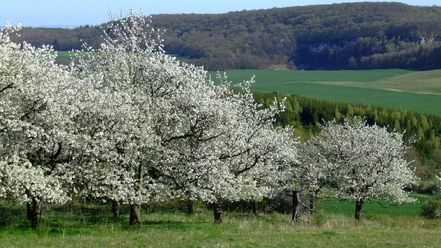
The route leads through the Natura 2000 area "Gypsum Karst Landscape Pölsfeld and Breiter Fleck in the South Harz". The long history of use and mining tradition have created valuable open-land habitats. (Orchard) meadows and dry grasslands alternate with oak and beech forests. Mining relics are ubiquitous and are described by numerous information boards along the karst hiking trail. The pale woodland warbler, green lizard, and hazel dormouse are native here. The Grillenburg, once built from bricks, was first documented in 1217.

Good to know
Pavements
- Asphalt (7%)Street (2%)Gravel (22%)Trail (66%)Path (3%)
Best to visit
- suitableDepends on weather
Directions
From Obersdorf, the hike follows the karst hiking trail over the Mohrungsberg towards Pölsfeld. From here, the path climbs the Pufferberg. At a rest area on the hill, a path marked with a green bar branches off towards Zollhaus. From there, the green-bar-marked path leads to the Grillenburg ruins at Grillenberg. After a tour around the Grillenburg ruins, a path marked with a red bar leads back towards Obersdorf. The path soon meets the karst hiking trail again, which leads back to the starting point of the hike.
Directions & Parking facilities
- Getting there
Obersdorf can be reached via the B86 from the direction of Mansfeld or Sangerhausen.
ParkingAt the church.
Public transportationObersdorf can be reached by bus, for example from Wippra and Sangerhausen.
Additional information
Rosenstadt Sangerhausen GmbH
Tourist Information at the Rosarium
Am Rosengarten 2a
06526 Sangerhausen
Tel: 03464 19433
info@sangerhausen-tourist.de
www.sangerhausen-tourist.deAuthor
Regionalverband Harz
Organization
Harz: Magische Gebirgswelt
License (master data)
Author´s Tip / Recommendation of the author
As early as the end of the 9th century, the village of Grillenberg was mentioned in the Hersfeld tithe register. The first documented evidence of the castle "Grellenberg" dates back to the year 1217. However, it was no longer inhabited in the 15th century and was left to decay. The red coloring comes from the building material. The castle was built from conglomerates and sandstone from the Rotliegend period (about 300 to 255 million years ago).
Nearby

Download GPX file